
Steward-Owned = Laureate of Radicale Vernieuwer 2026
Steward-Owned has been selected as one of the ten Radicale Vernieuwers (Radical Innovators). This is a wonderful recognition for this still young movement. A recognition that we celebrate not only for ourselves, but for everyone who believes that ownership is the most underestimated piece of the puzzle in the transition towards the kind of economy our society truly needs.
What are the Radicale Vernieuwers?
Every 2 year, Sociale Innovatiefabriek—the organization behind Radicale Vernieuwers—searches for solutions that do not merely optimize the existing system, but fundamentally rethink it.
No layers of varnish.
No incremental improvements.
Real paradigm shifts.
Initiatives that respond to urgent societal challenges by questioning the deepest assumptions of our current system.
Every two years, ten laureates are selected. This year, we are one of them.
Oh yes, there is also a public award.
Not so surprising, you might think. Because rethinking a deep assumption is precisely what Steward ownership is all about.
The way ownership is organized turns out to be a crucial factor in whether a company continues to pursue its societal purpose over the long term—or not.
Is Steward Ownership really that radical?
Yes & No
Yes, because Steward Ownership is absolutely a paradigm shift. It requires unlearning much of what we have been taught for decades. It is about radically rethinking ownership: moving away from financial gravity and separating control rights from economic rights in a company.
That sounds rather radical. And innovative.
Or, as some would put it:
“This is not woke capitalism, it’s the future of business.”
- Patagonia -
Ownership, in a sense, is the next frontier for realizing purpose and multi-stakeholder capitalism. But while we’re talking about the future, steward ownership actually takes us back to the origins of corporations.
Although the term was only first coined in 2016, it is at the same time a very old idea, applied by pioneers such as Bosch, Zeiss, and Carlsberg since the nineteenth century. More fundamentally, the philosophy itself traces back to ancient notions of responsibility and custodianship.
It is about responsible ownership. It is about intergenerational ownership.
Yet steward ownership stands in sharp contrast to the way companies have increasingly been designed over recent decades: businesses as cash cows, as tradable commodities.
And that is exactly what we need to move beyond.
A business can be a prototype of the world you want to live in.
That does not sound so radical after all, does it?
People rarely question business ownership. Yet it quietly shapes everything: who holds power, how decisions are made, what gets prioritized, and ultimately what endures.
The only business of business is business
There is a flaw in the way we have built our economy. Not a flaw on the surface, but deep within the structure itself. In the way ownership is organized.
For decades, the dominant logic has been clear: businesses exist to maximize shareholder value. Milton Friedman famously stated in 1970: “The only social responsibility of business is to increase its profits.” That sentence has shaped economic thinking far more deeply than many of us realize.
The consequence?
Even the most committed entrepreneurs and the most mission-driven companies operate within a structure that risks placing financial logic above mission over time. Not because of bad intentions. But by design. It is like a magnetic field that companies are eventually pulled towards—especially during pivotal moments, when things are going exceptionally well or exceptionally badly.
Mission drift. Short-termism. Companies traded as assets.
These are not aberrations. They are, unfortunately, the logical—and sometimes unavoidable—outcomes of an ownership system designed in the wrong way.
More fundamentally: can we really expect companies within a shareholder economy to consistently prioritize the common good when they were never structurally designed to do so? It is a system built around “capitalizing the gains and socializing the losses,” regardless of how good the intentions of many actors may be.
The missing piece of the puzzle
Steward Ownership is not an intention, not a new law, not a subsidy scheme, not a label. It is a fundamental reinvention of what ownership can mean.
And the idea is surprisingly simple.
What if companies were built around two principles?
1. Self-determination
The existential control over a company is no longer for sale and cannot be inherited. Instead, it is passed on to people who are deeply connected to the mission—the steward-owners. They guide the company based on continuity, independence, and purpose.
2. Purpose orientation
Profits can never be extracted indefinitely. They are used in service of the mission. Founders and investors can receive a fair—but limited—financial return. Profit serves purpose. Profit is a means, not an end in itself.
And these two principles are irreversibly embedded into the legal DNA of the company.
Only two principles. Yet the impact is immense. Because when ownership is organized differently, everything changes: whose voice matters, how success is defined, and under which logic the most consequential decisions are made.
Companies such as Patagonia, Bosch, Ecosia, Signal, The Guardian, and even De Efteling are steward-owned already for decades, or more recently. Globally, the movement is growing rapidly: more than 2,000 purpose-driven companies and a trajectory that could soon see the number doubling every year.
Our economy is a system of power. Ownership is a system of power. If ownership determines the rules through which power and value are distributed, then systemic change ultimately means: changing the logic of ownership itself.
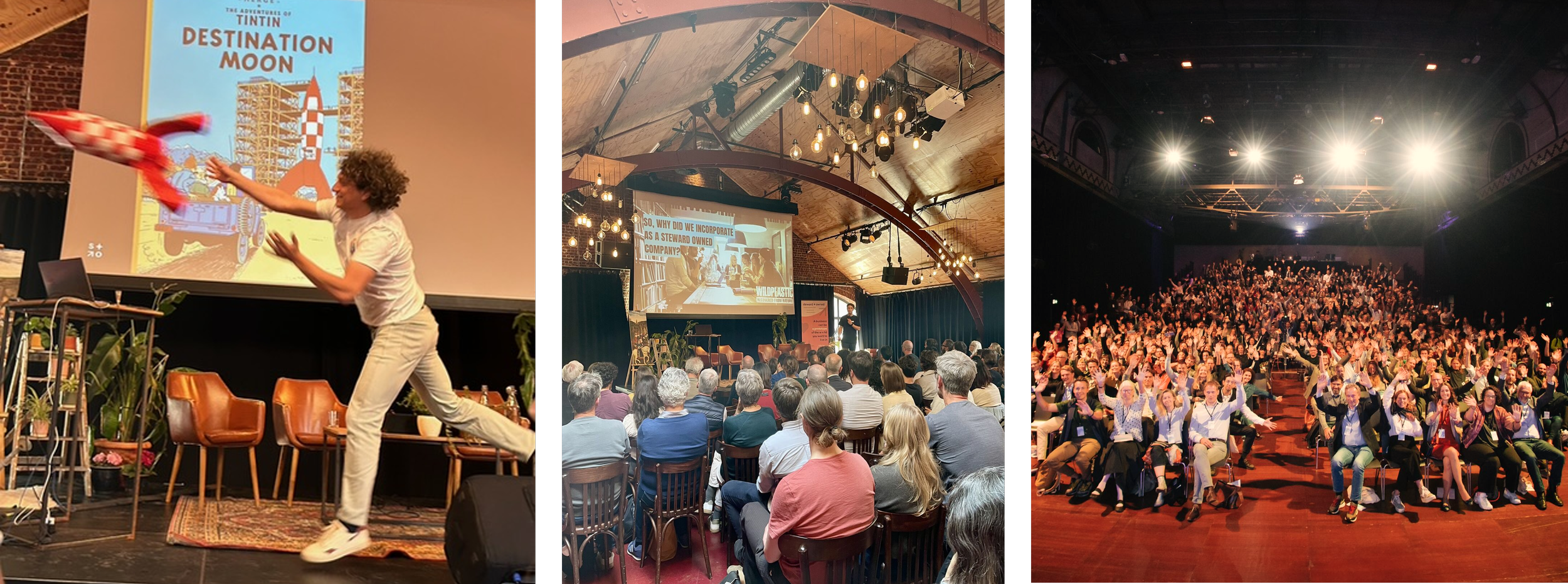
The Belgian movement
In October 2024, supported by the broader Purpose ecosystem, we launched the Belgian movement with 18 ambassadors, a launch event in May 2025, and a growing ecosystem of partners, financiers, and pioneers.
And the movement is growing faster than expected. Hundreds of companies and investors have reached out with questions. Forty exploration processes have been started. And already in 2026, eight companies—from startups and SMEs to family businesses—decided to become steward-owned.
The narrative is shifting. Not from what companies do, but from how companies organize ownership and power. Because that is where the deepest lever for real change lies.
And that global movement are we accelerating here in Belgium. We are pushing every button necessary to make it happen.
What this recognition means
Being selected as a Radicale Vernieuwer confirms that ownership—a topic that long seemed merely technical or legal—is now increasingly recognized as a crucial societal issue.
Of course, we are grateful for the recognition. But above all, it should act as a catalyst. Because the real ambition is much bigger: that every entrepreneur, every radical innovator, and every shareholder in Belgium knows this alternative exists.
That Steward Ownership is a real and accessible option.
That a company can genuinely exist for its mission—for the long term, potentially forever. At least for those willing to radically rethink something that may seem as seemingly “boring” as ownership.
It means unlearning what we have been taught for so long.
Moving away from financial gravity.
Radically rethinking ownership.
And it starts here. In Belgium. Now.
Only then can we build truly independent and purpose-driven companies for the future.
Are you an entrepreneur, investor, or policymaker and would like to learn more about Steward Ownership?
Get in touch or subscribe to our newsletter.